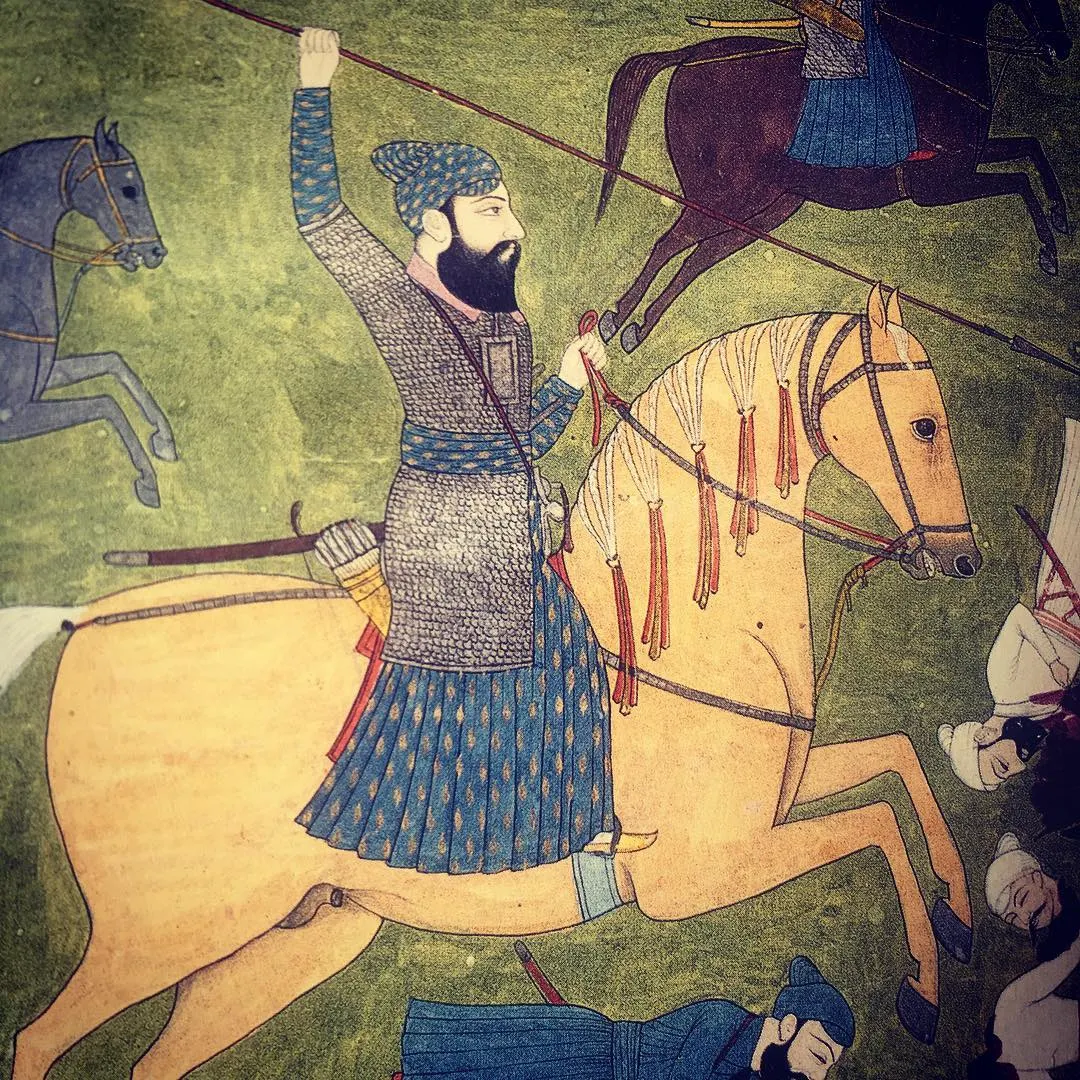
The Rise and Fall of Banda Singh Bahadur | Part 2 of 3
Here is the second excerpt from my book about the legendary Sikh warrior Banda Singh Bahadur.

Here's part 1 of this series.
In 1709, Banda officially announced himself to the Mughals by routing the unsuspecting city of Sonipat, just north of Delhi. Banda looted the state treasury and the homes of the wealthy, sharing the spoils among his men. Emboldened by his victory, many more joined Banda’s call as he marched 120 miles north to Samana, the home of the executioners of the ninth Sikh guru, Guru Tegh Bahadur. Banda’s forces quickly overwhelmed the city and, after three days of carnage, left thousands dead in the streets and the city a smoking ruin.
Banda quickly became unstoppable, capturing several more Mughal strongholds throughout the Malwa region between the Sutlej and Yamuna Rivers (the Sutlej is considered the southeast border of Punjab; the Yamuna runs further east near Delhi). Banda and his men showed no mercy as they ferociously sacked city after city, their shock tactics stunning the Mughal forces each time. A century later, British military officer Sir John Malcolm in India wrote of Banda's army: “Every excess that the most wanton barbarity could commit, every cruelty that an unappeased appetite of revenge could suggest, was inflicted upon the miserable inhabitants of the provinces through which they passed. Life was only granted to those who conformed to the religion and adopted the habits and dress of the Sikhs.”
This bloody, victorious march brought Banda and his troops near Sirhind, home of Wazir Khan. They were quickly cornered by the Mughal army and severely outgunned––Banda’s civilian-soldiers, armed with spears and hatchets, faced Mughal cannons, elephants, and muskets. But the Sikhs outnumbered the Mughals, so instead of fighting on an open plain, Banda lured the Mughals into the forest. There he forced the Mughals into close-quarter combat and used small hills to shield his men, rendering the Mughal war elephants and cannons useless. Without any military experience or training, Banda led his men to a decisive victory, which would be memorialized by the construction of the Fateh Burj more than three hundred years later. After they routed the Mughal forces, Banda's army marched into Sirhind, destroyed the city and executed Wazir Khan––the deaths of Guru Gobind Singh’s sons were finally avenged.

Through the summer, Banda continued his campaigns north into the heart of Punjab, and by August 1710, he had seized the cities of Jalandhar and Hoshiarpur. Banda had now conquered all the territories between the Sutlej and Yamuna Rivers and thousands of Hindus and Muslims converted to Sikhism––by their own beliefs, to avoid execution or to join the plunder and reap the spoils of war. He established his rule by declaring a new calendar and minting coins inscribed with his battle cry: “Degh Tegh Fateh,” which loosely translates to: “Victory for those that give and bear arms for the oppressed.” He also abolished large Mughal farmlands in southern Punjab, breaking up the estates and giving them back to Sikh and Hindu farmers. Banda then made his home in the northern reaches of his new realm, in the foothills of the Himalayan Mountains, where he had a clear view of any potential attacks.
Inspired by Banda’s spectacular victories, the Sikh and Hindu peasants and farmers of Punjab led their own uprising, reclaiming most of the territory near Lahore, which was only eighty miles west of Jalandhar. If Banda had united their efforts with his own, these combined Sikh forces likely could have taken the city of Lahore and claimed all of Punjab as free from Mughal rule.
Meanwhile, the Mughal Emperor was busy in Rajasthan trying to subdue the revolting Rajputs during Banda’s rampage. When Emperor Shah discovered his empire’s vast losses, he marshaled all of his forces to smash the rebellion. By December, the Mughals had recaptured all of their territory from Jalandhar to Samana, and Banda fled to his fortress in the mountains. For the next few years, he would periodically emerge to lead a strike and regain some ground, which he would quickly lose to Mughal counterattacks. Bahadur Shah suddenly died in 1712, and the new emperor, Jahandar Shah, focused all his energies on destroying the Punjab rebellion once and for all. The Mughals drove Banda further into the mountains and wiped out the last of the rebels.
Banda gave up his sword for domestic life and remained in the mountains with his children and two wives for the next three years. I couldn’t find any explanation for his sudden shift to start a family, but perhaps he realized he couldn’t defeat the Mughals? Or was content with his efforts thus far, leaving behind those he had once led? But the peasants remained restless beneath the oppressive boot of the Mughals, and in 1715, seven thousand men mounted a failed attack on Rupnagar, which seemed to inspire Banda 120 miles away. He proclaimed another uprising and once again came roaring down the mountains.
A pitched battle between Banda's forces and the Mughals just south of the mountains at Batala almost led to a shocking Mughal defeat. Banda retreated from one village to another and once again into the mountains, but instead of hiding in the passes, he made a stand at Gurdaspur. There, the man who was renowned for his brilliant military tactics made a careless mistake. He dug a moat to prevent the Mughals from crossing the flooded lands with their cannons, but in the process, he cut off his access to food and other supplies. The Mughals waited for Banda and his men to starve themselves into submission.

They somehow managed to hold out for another eight months. On December 7, 1715, Banda Singh was finally captured. He was imprisoned like a wild beast, in an iron cage with an iron collar around his neck and carried to Delhi on a cart. His men marched behind him with iron chains shackled to their necks, hands, and feet. The Mughal soldiers added to the procession by capturing Sikhs along the way until they had about 700 prisoners and carts full of severed heads. When they arrived in Delhi at the end of February, the Mughals paraded their captives through the streets so the people could witness Banda and the Sikh rebels in chains. Banda was dressed like a pauper king, mocking his grand proclamations.
Continue to Part 3 of 3
Punjab Now and Then Newsletter
Join the newsletter to receive the latest updates in your inbox.